
The Local Visibility Crisis: Why Good Businesses Feel Invisible in 2026

A lot of business owners think they have a lead problem.
What they really have is a visibility problem.
And in 2026, that difference is everything. You can be good at what you do, care about your customers, answer your phone, do the work right, and still feel like the market is ignoring you. Not because your business suddenly got worse, but because the way people find, evaluate, and choose businesses changed faster than most owners adapted.
Customers are not moving through search the old way anymore. They are seeing AI Overviews, Google Maps summaries, reviews, YouTube videos, and conversational answers before they ever visit a website. A lot of the decision is happening before the click, which means the business that feels easiest to trust is often the one that gets chosen.
When a good business starts disappearing
Most businesses did not build their online presence all at once.
A website came first.Then a Google Business Profile.Then maybe Facebook.Then maybe Instagram.Maybe YouTube got added later.Maybe LinkedIn was never really part of the system.
The issue is not that any of those things are bad.
The issue is that they often stopped telling the same story.
The website says one thing.The GBP looks old.The photos are stale.The reviews are there, but nobody is responding.The content does not match what customers are actually asking.The business is still working, but online it looks quiet.
And quiet online gets interpreted as risk.
That is the part a lot of marketers miss when they talk about “signals” and “ecosystems.” Real people are not thinking in those terms. They are thinking, Do I trust this business enough to call? If the answer is not immediate, they keep moving.
Why the website is not enough
There is still a stubborn idea that the website is the whole game.
It is not.
The website matters, but now it is one proof point in a much larger trust check.
People are not just searching “roofer near me” or “mold remediation company.” They are asking things like:
“How do I know if this is serious?”
“What should I expect after I call?”
“Who actually seems like they know what they are doing?”
“Is this company active or did they set this up years ago and forget it?”
That is what search feels like now. It is not just about information. It is about relief. People want to know they are not wasting time, money, or energy on the wrong choice.
That is why thin brochure websites keep underperforming. They answer too little, too late. The businesses doing better are the ones that explain the problem, the process, and the outcome in a way that makes a person feel calmer and more certain.
Why Google Business Profile matters so much
For a lot of customers, Google Business Profile is the first real impression.
Sometimes it is the only one.
Before they click anything, they are scanning:
Reviews.
Photos.
Hours.
Services.
Updates.
Whether the business looks current.
If the profile looks alive, it creates confidence.
If it looks neglected, it creates doubt.
That is why GBP is not a side task anymore. It is a front-door trust signal. In 2026, Google is using richer local data and AI-driven surfaces that draw from reviews, posts, service details, and other profile content, so stale or thin profiles are easier to overlook.
And this part matters: customers are not separating “your website” from “your Google profile” from “your social media.” They are reading the whole thing as one impression. If it feels disconnected, they feel it immediately.
Why reviews carry so much weight
Reviews used to be social proof.
Now they are trust confirmation.
A business with recent, specific reviews feels active.A business with old, vague reviews feels less certain.A business that responds feels present.A business that ignores them feels distant.
People can tell the difference fast.
And Google can too.
The language inside reviews matters as well. When customers naturally mention the service, the location, the communication, and the experience, those details help reinforce what the business actually does and who it serves. In 2026, review freshness, response behavior, and detail level all contribute to how visible and believable a business feels.
That is why review strategy cannot be a once-in-a-while push. It has to be part of the operating rhythm.
Why some businesses are spending effort in the wrong places
A lot of business owners are busy.
They are posting everywhere.They are trying to keep up with every trend.They are chasing attention in places that do not actually move the needle for their kind of business.
That is not a discipline problem. It is a prioritization problem.
Not every platform deserves equal effort.
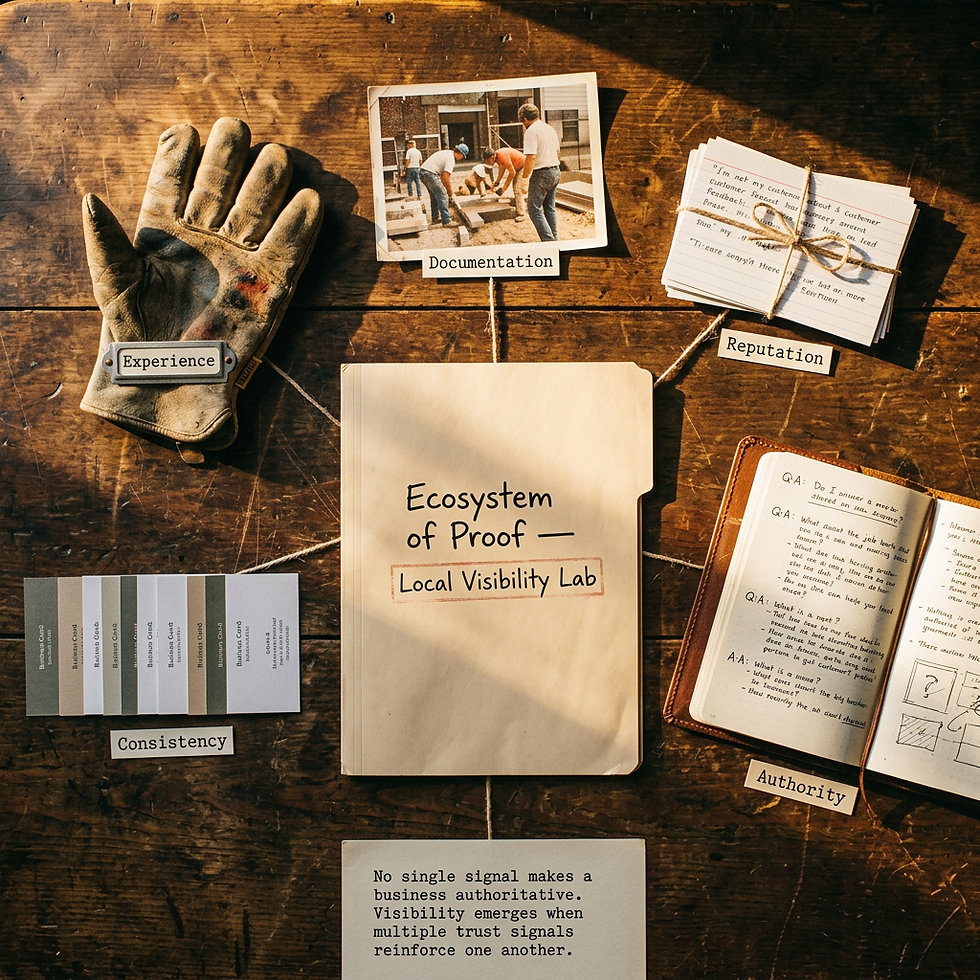
For many local businesses, the real job is not “be everywhere.” It is “make the important places agree.”
That means:
The website explains the work.
The GBP proves the business is real and active.
The reviews validate the experience.
The videos show the personality and process.
LinkedIn reinforces authority and relationships.
Local community presence makes the business feel rooted.
That is what visibility looks like now. Not random posting. Reinforcement.
Why YouTube matters more than people admit
A lot of small businesses still think YouTube is only for creators, entertainers, or companies with huge production budgets.
It is not.
It is one of the simplest ways to reduce uncertainty.
A short video explaining a common problem, showing a process, or answering a question can do more for trust than a perfect sales page ever will. It gives people a chance to hear how you talk, how you think, and how you explain things. That matters because the real hesitation is rarely about the service itself. It is about whether the business feels like a safe decision.
And that fits the way search is changing. The more conversational search becomes, the more people want human explanations instead of robotic summaries. YouTube gives them that better than most formats.
Why search feels more human now
Search used to feel technical.
Now it feels emotional.
People are typing full questions.They are speaking searches out loud.They are asking for reassurance as much as information.
That means content has to sound like a person wrote it for another person.
Not corporate.Not over-optimized.Not stuffed with jargon.Not pretending to be neutral when it should be helpful.
Just clear.
Just real.
Just useful.
That is why generic AI content fails so fast. It may be structurally correct, but it often lacks the lived-in feel of actual expertise. And in 2026, people can tell when a business is speaking from experience versus just filling space.
What this crisis really means
The Local Visibility Crisis is not just about losing rankings.
It is about losing the moment of trust.
That is the real shift.
You can still be a good business and still get passed over if your online presence feels inconsistent, stale, or too hard to interpret. You can still have real expertise and still lose the lead if the customer has to do too much work to understand why you are the right choice.
That is why visibility in 2026 is not just about traffic.
It is about being easy to:
find.
understand.
trust.
remember.
recommend.
The businesses that win are not always the loudest. They are the ones that keep making the same truth easier to see across every place a customer looks.
What to do first
If a business feels invisible, the fix is usually not “post more.”
It is “make the business easier to believe.”
Start with:
A current, complete Google Business Profile.
Recent reviews and real responses.
Website pages that answer actual customer questions.
Fresh photos and signs of activity.
A few simple videos that show what the business does and why it matters.
A consistent story across every surface that appears in search.
That is the base layer.
Not because it is trendy.
Because in 2026, customers are deciding faster, trusting less automatically, and relying more on the full picture than on any single platform.

Comments